Open Box




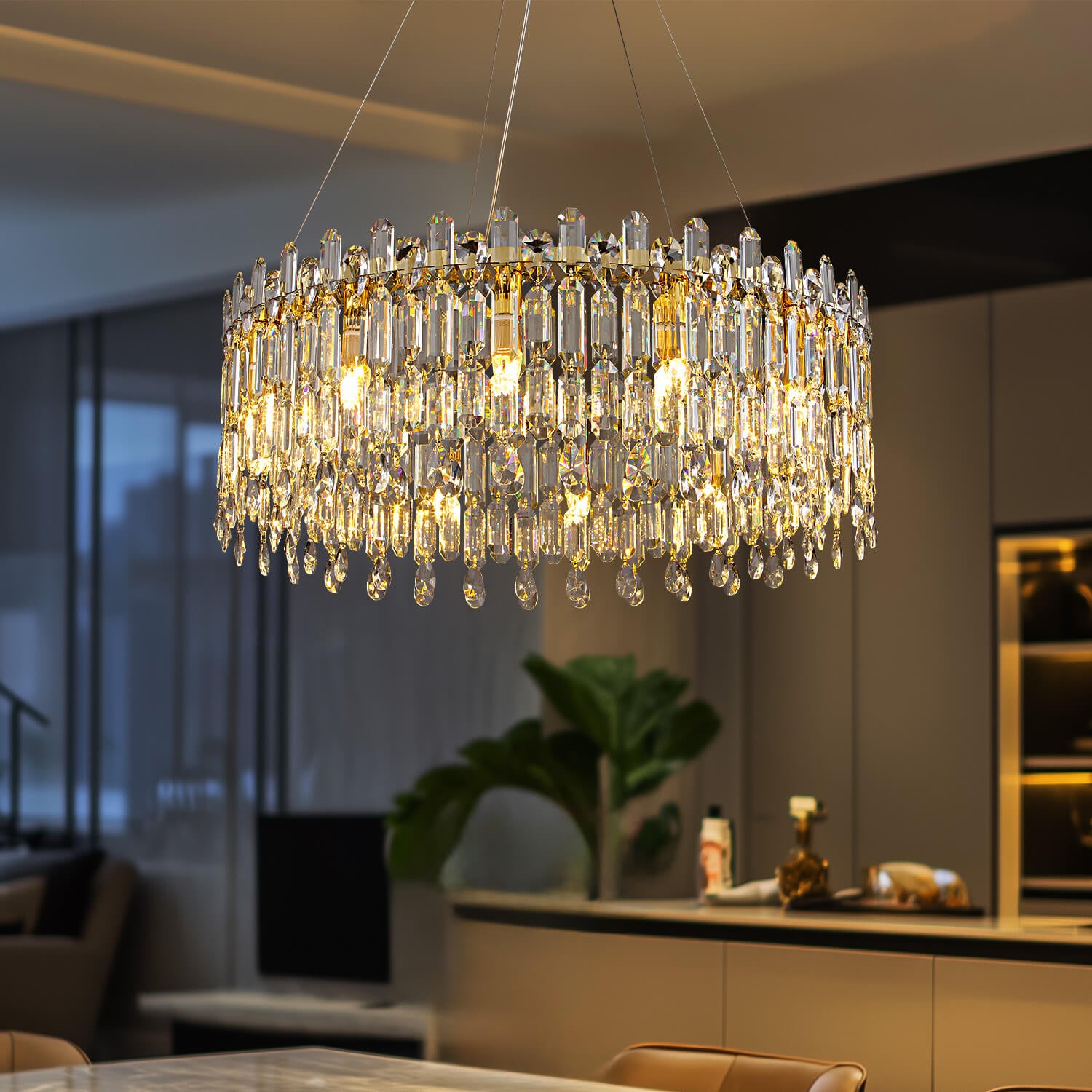
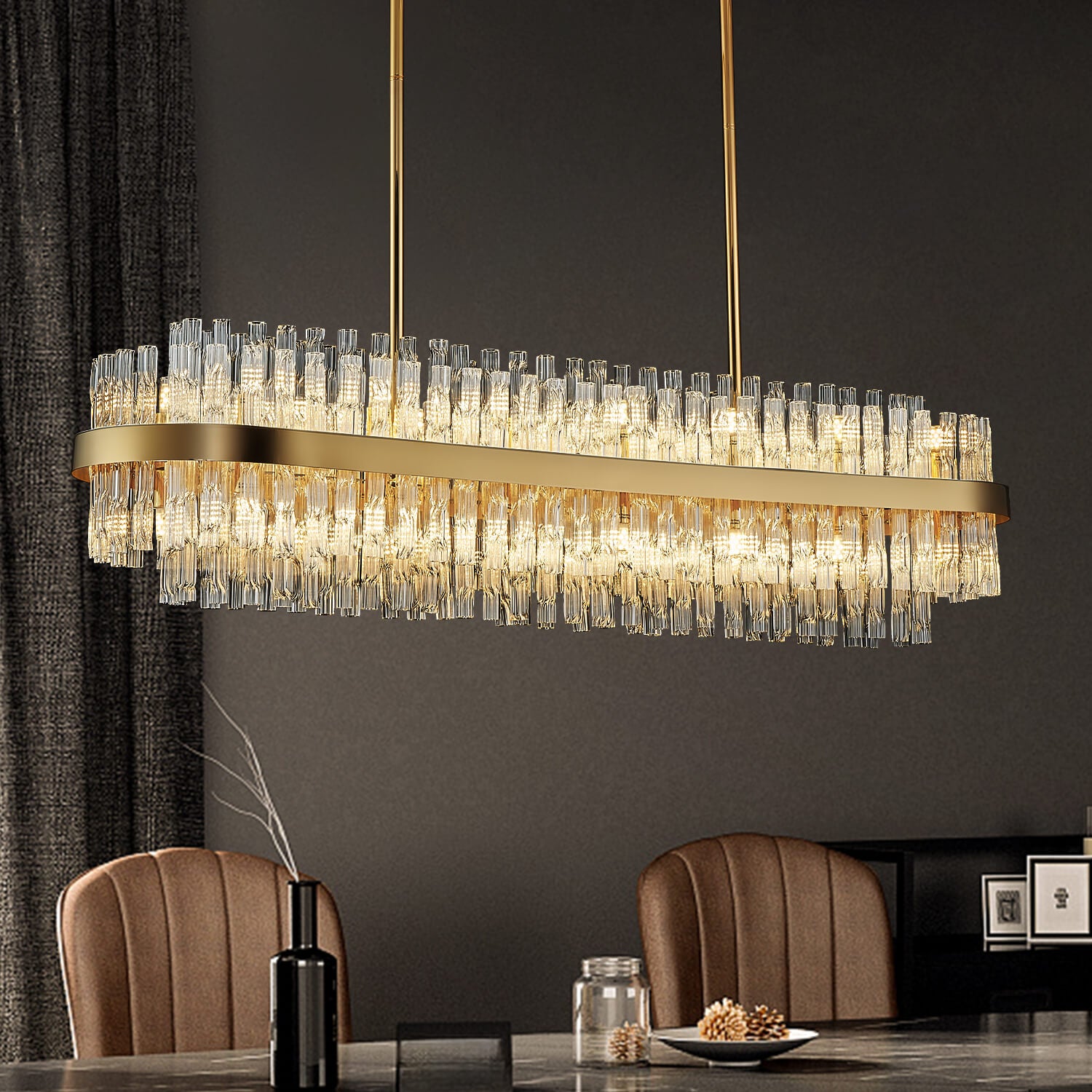


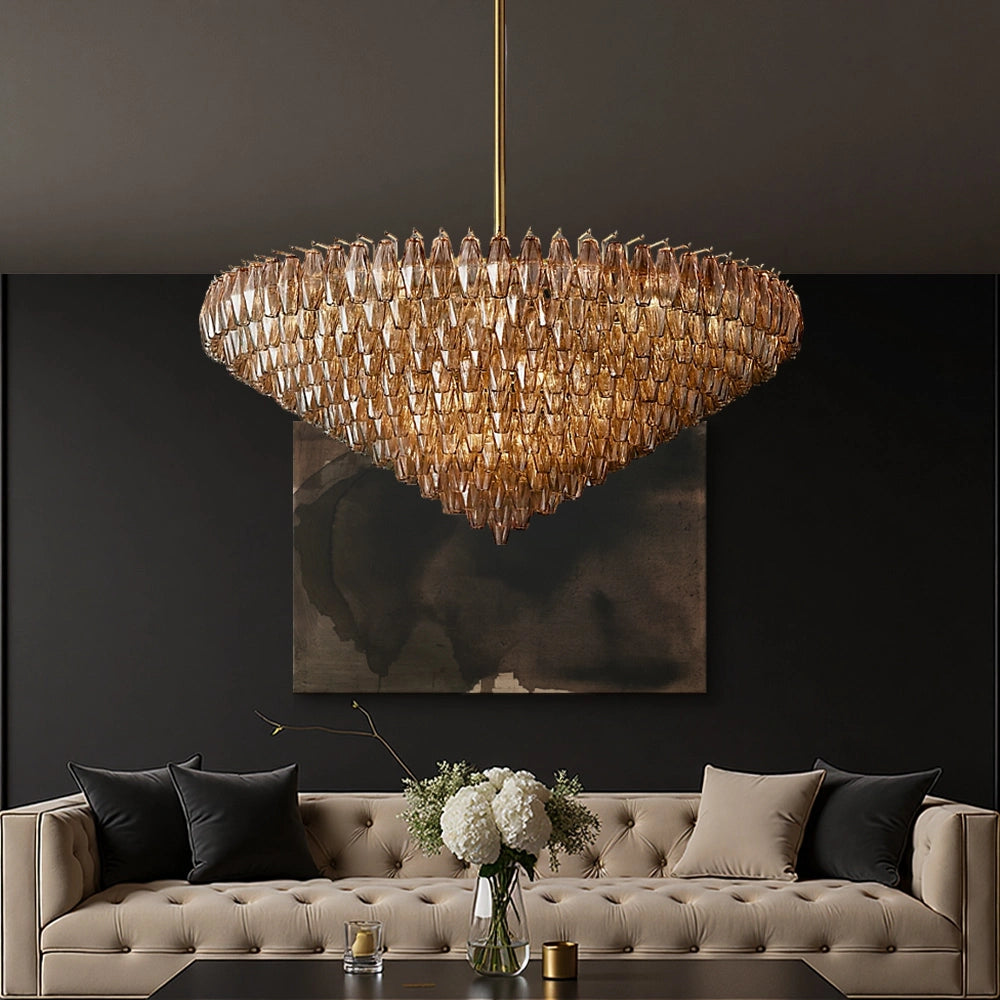
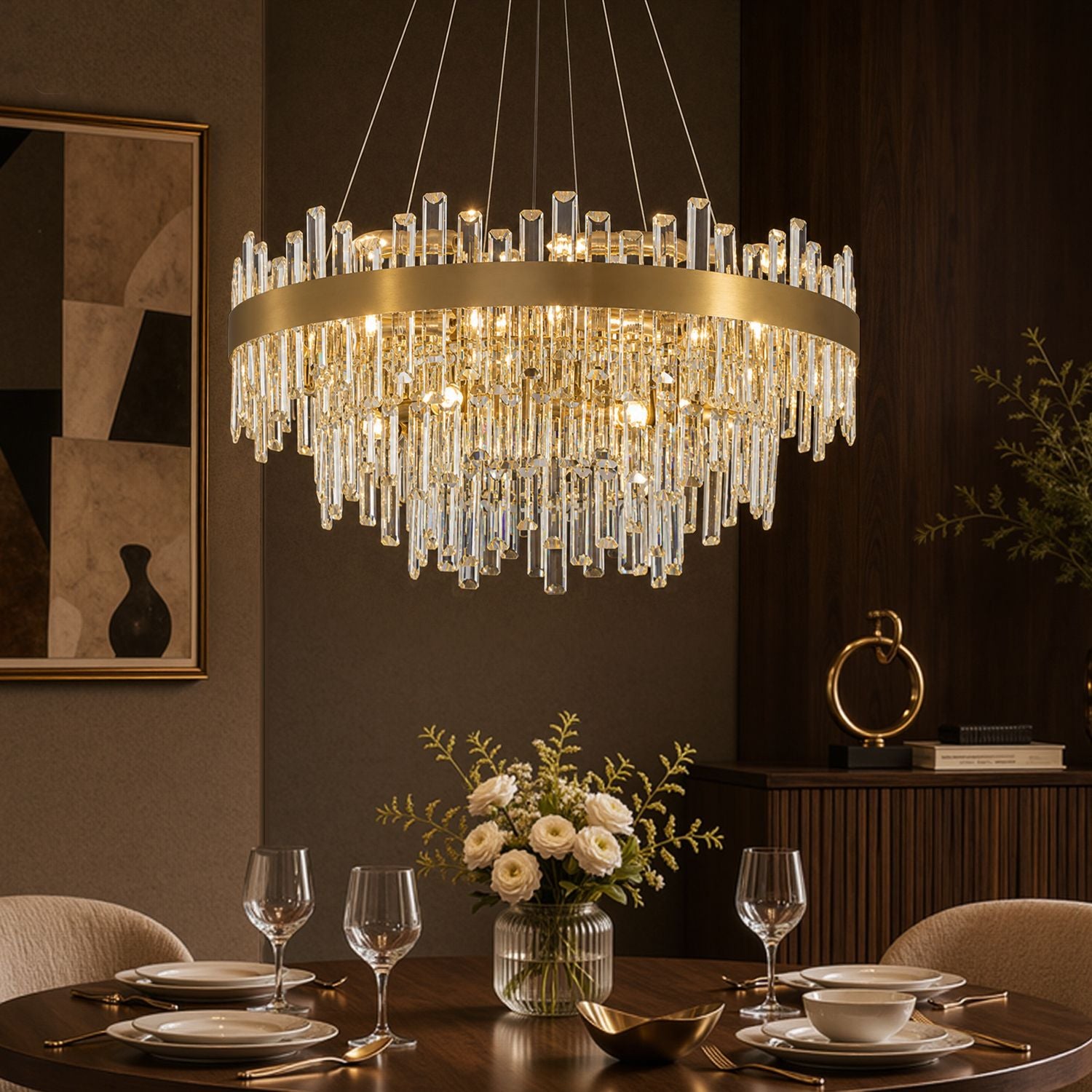
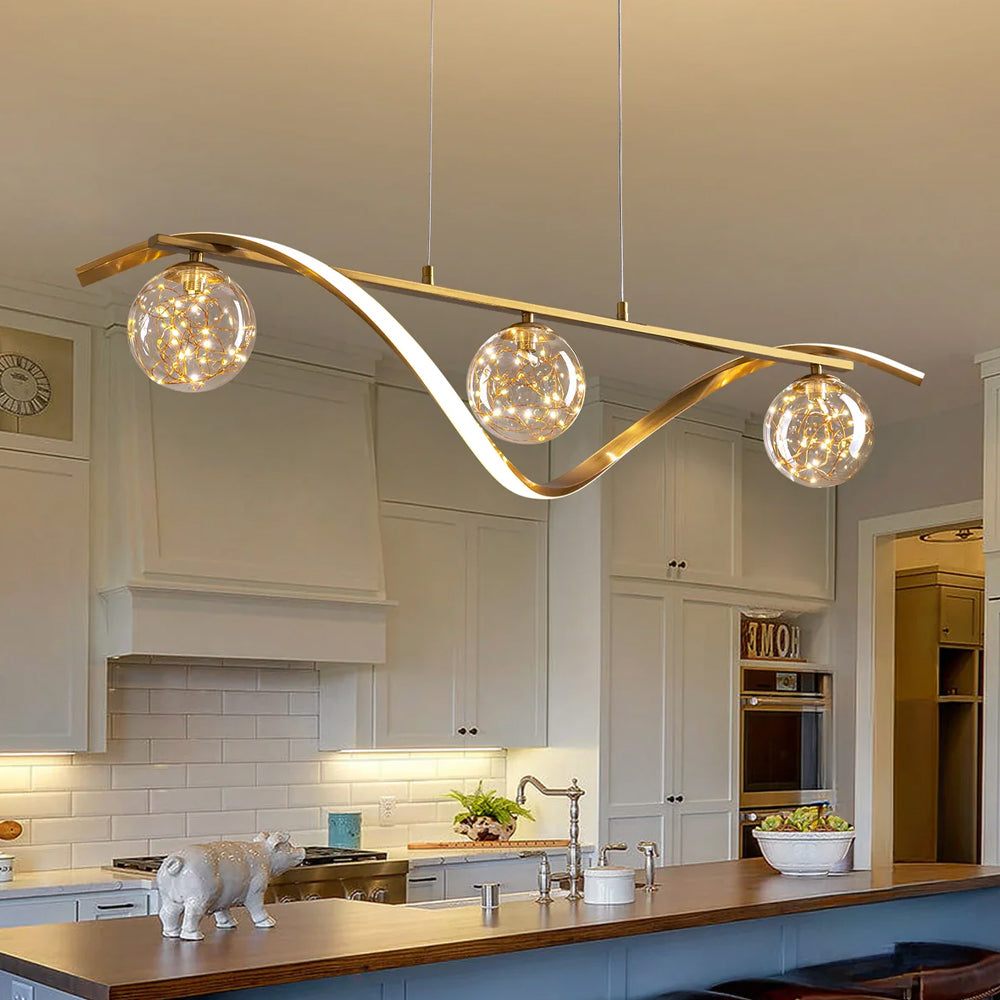
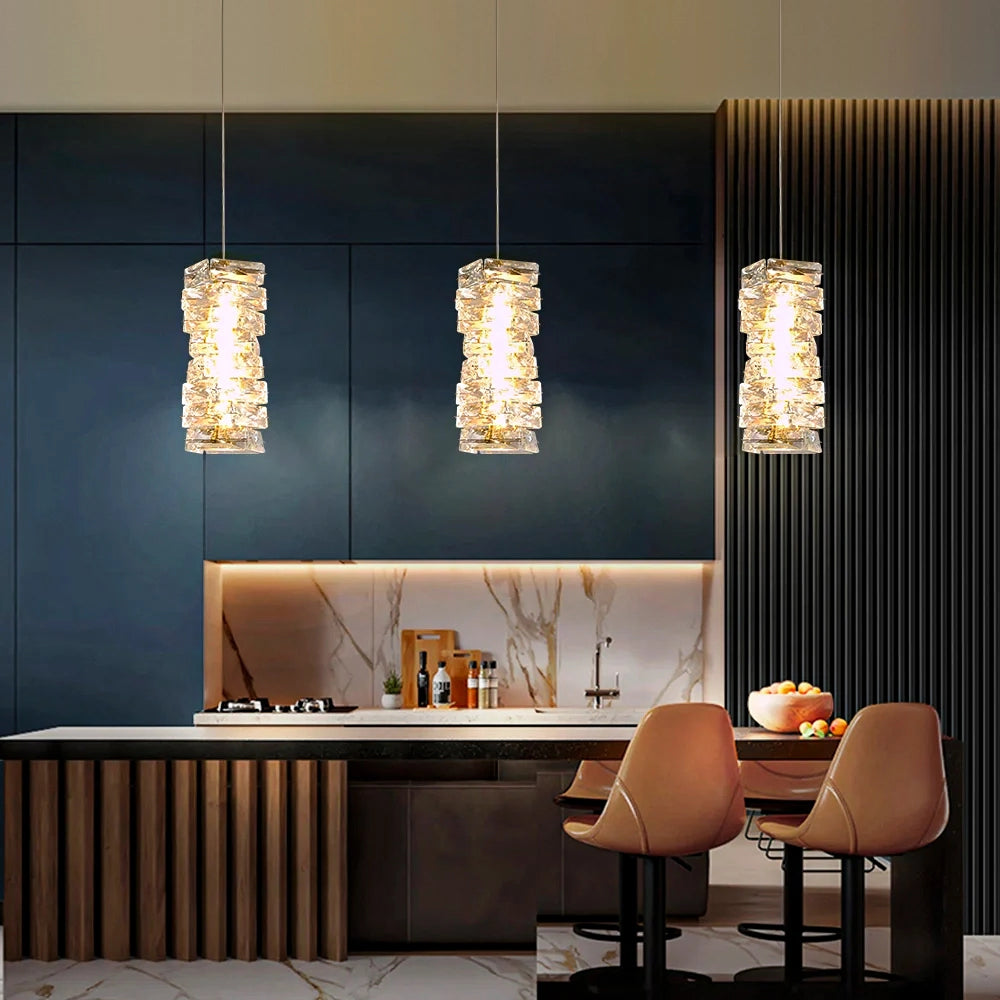


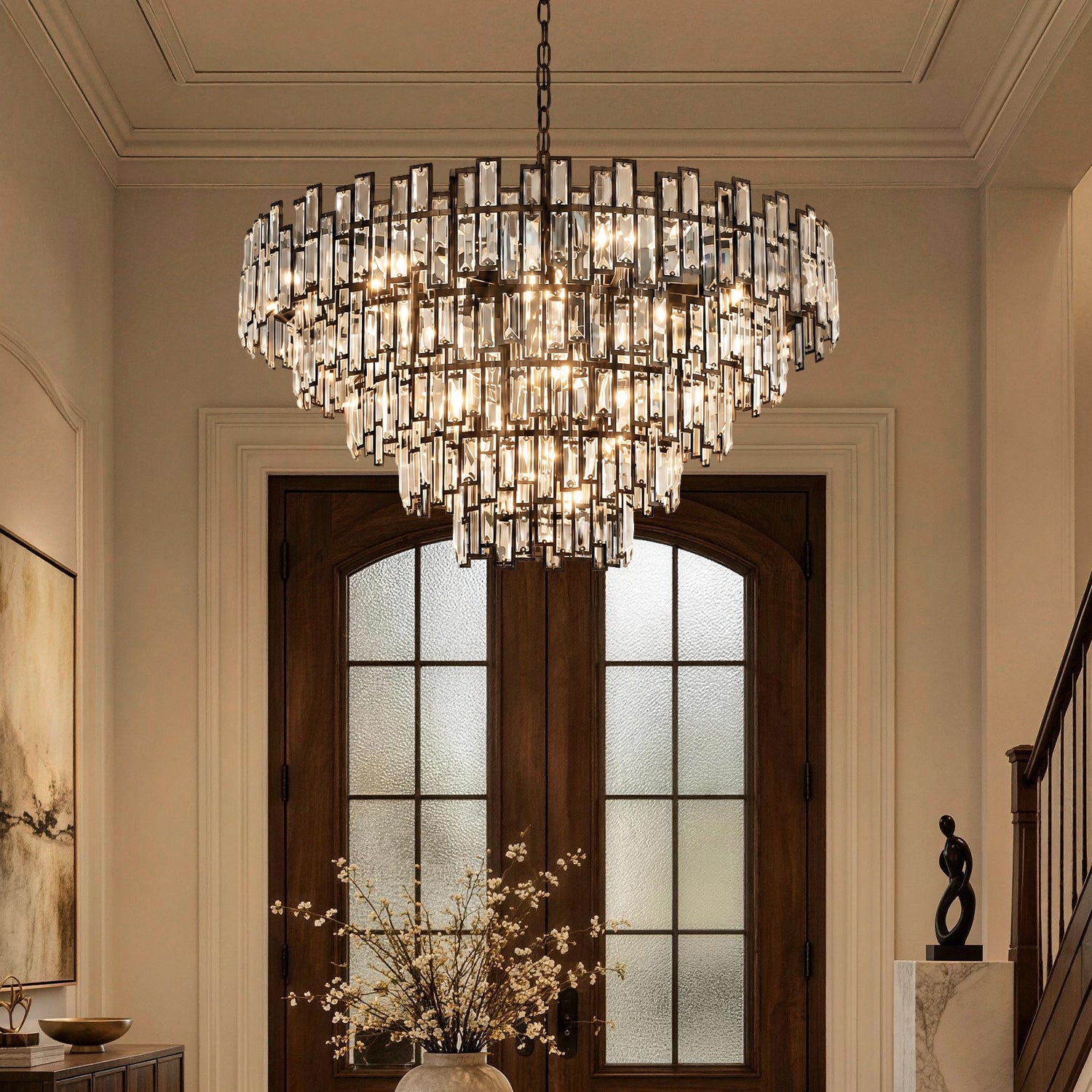

K9 Crystal vs. Lead Crystal vs. Glass: What Chandelier Buyers Should Know
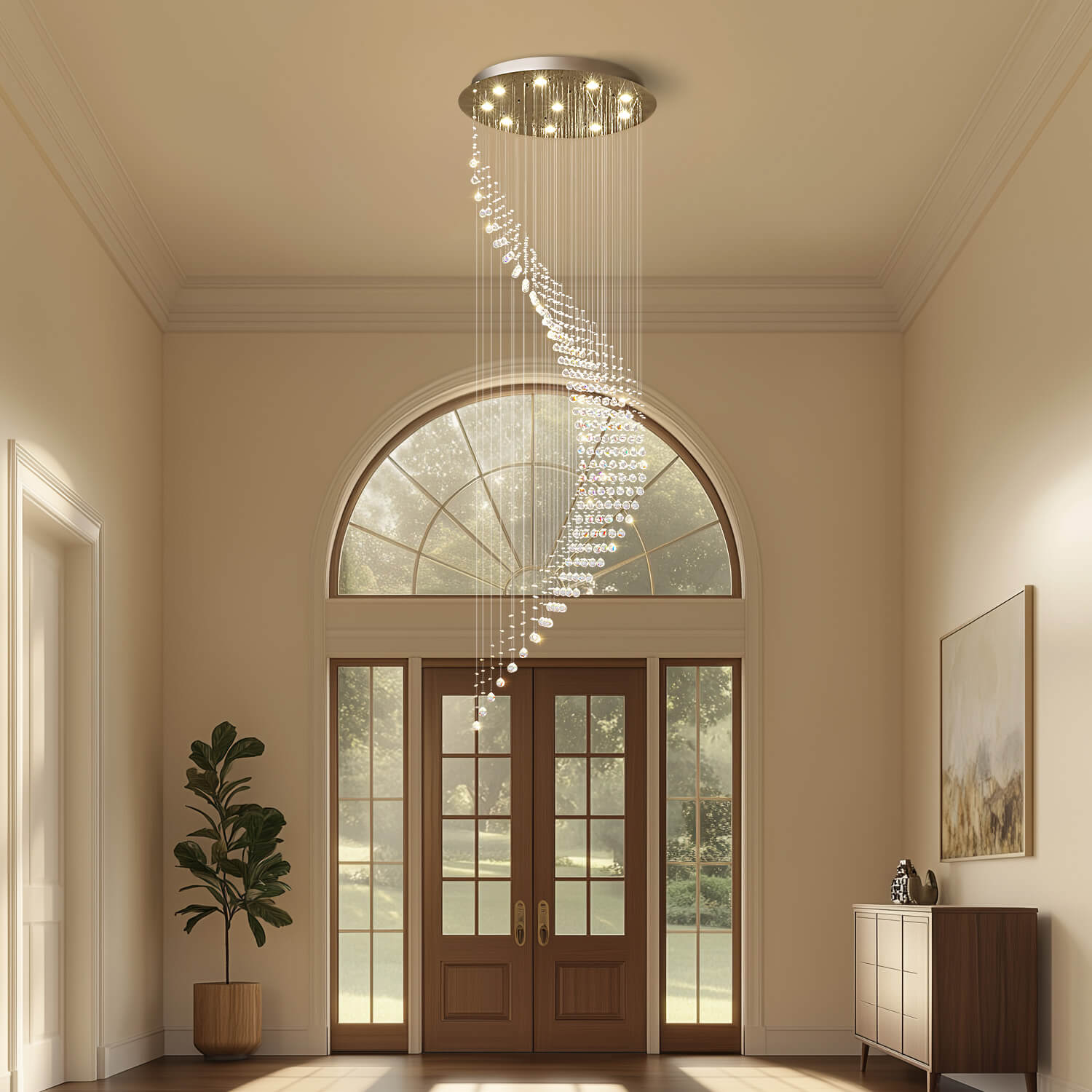
Quick answer: K9 crystal, lead crystal and ordinary decorative glass are not three simple quality grades. In the Chinese lighting supply chain, K9 is a name associated with optical crown glass used for clear, faceted chandelier components. Lead crystal is a separate glass family whose lead-oxide content must be verified, while “glass” is a broad material description that says little about clarity, cutting or finish by itself. For a chandelier, the best choice depends on documented material, facet quality, fixture weight, light-source placement, installation requirements and replacement support—not the word “crystal” alone.
Research date: August 31, 2026. This guide uses the Chinese optical-glass context for K9 because Sofary’s K9 chandelier products are sourced through the Chinese lighting supply chain. Where a current Sofary product page says “K9 crystal” but does not publish a chemical analysis or a specific H-K9L certificate, this article does not infer a fixed lead content.
K9 crystal vs. lead crystal vs. glass: the short comparison
The fastest way to compare these materials is to separate the material name from the finished chandelier component. A clear glass blank can still look flat if it is poorly cut or polished. Conversely, a well-made decorative glass prism can look excellent when its facets, proportions and light-source placement are carefully designed.
| Material label | What it usually means | What the name does not prove | Most useful buying check |
|---|---|---|---|
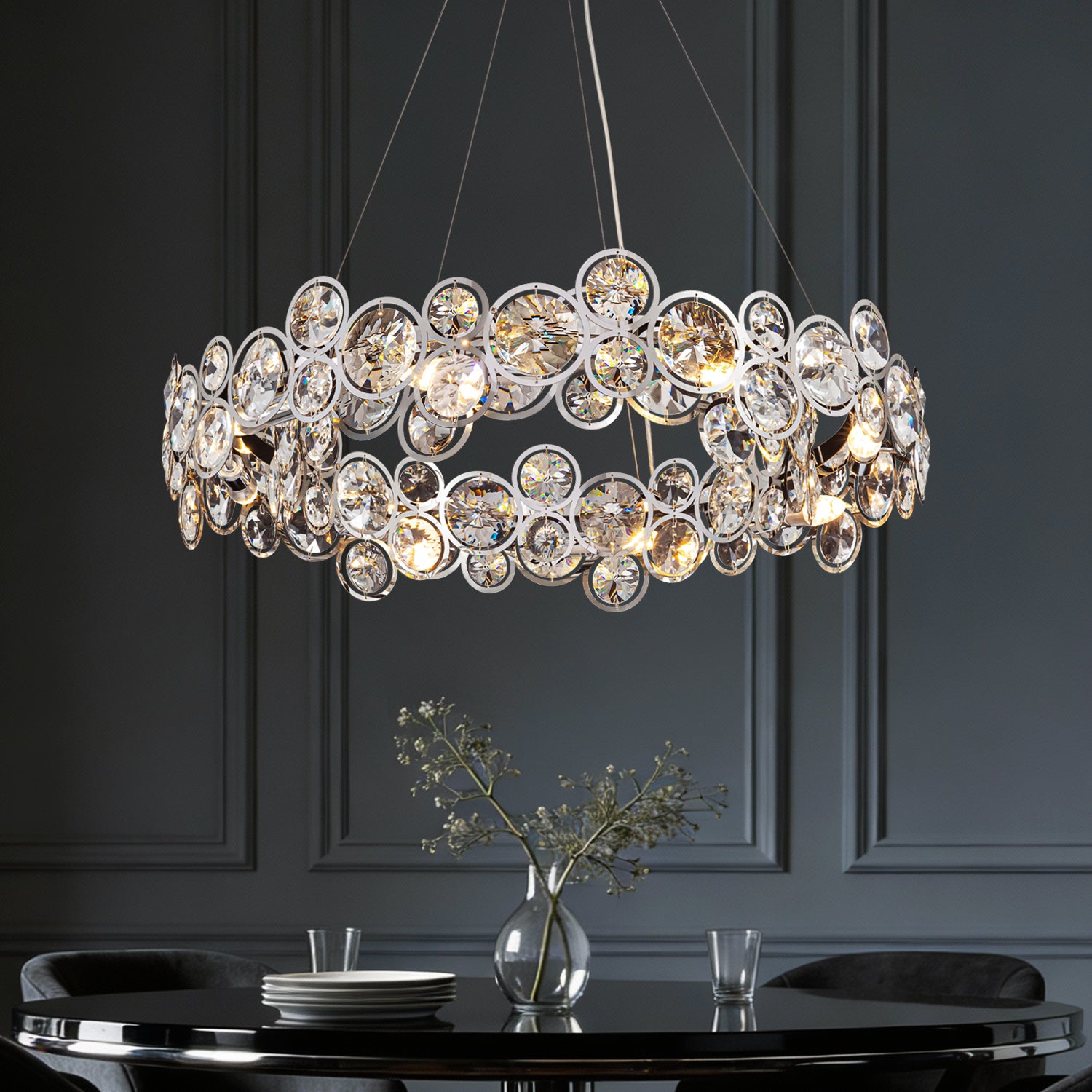
| K9 crystal | A chandelier-industry name associated with Chinese K9-type optical crown glass, cut and polished into decorative prisms, rods or drops. | A fixed lead percentage, a specific H-K9L grade, or precision-optics tolerances. | Ask what exact grade or supplier declaration supports the K9 description. |
| Lead crystal | Silicate glass formulated with lead oxide. Exact definitions and permitted labels depend on the market. | Better overall chandelier quality, safer support, cleaner cutting or superior value. | Request the declared PbO content and include the finished fixture weight in the installation plan. |
| Decorative glass | A broad category that may include molded shades, hand-blown forms, cast elements or cut glass prisms. | Low quality. “Glass” alone does not describe optical clarity, composition, forming method or finish. | Inspect close-up images, edge finishing, consistency, replacement availability and the complete fixture specification. |
What K9 means in the Chinese optical-glass context
For this guide, K9 is treated first as a Chinese optical-glass designation, not as a U.S. legal grade and not as a percentage statement. Chinese technical materials describe K9 as an optical crown-glass type. A published Chinese K9 glass formulation lists silica, boron oxide, potassium oxide, sodium oxide, barium oxide and other constituents, but does not list lead oxide in that formulation. This is one reason buyers should not decode the “9” as a guaranteed 9% PbO content.
The modern designation H-K9L is also widely encountered. CDGM currently lists H-K9L among its colorless optical glasses. Its optical code is commonly cross-referenced with other manufacturers’ crown glasses, including SCHOTT N-BK7. SCHOTT publishes an N-BK7 refractive index of 1.51680 and an Abbe number of 64.17. Those values help describe an optical-glass family; they do not prove that every chandelier prism sold as “K9 crystal” was produced to the same composition, homogeneity or tolerance as a certified optical blank.
Important distinction: “K9 crystal” on a chandelier page is a commercial material description. “H-K9L” is a more specific optical-glass designation. Unless the exact grade is published or documented by the supplier, the two terms should not be treated as automatically interchangeable.
Cross-reference tables also require care. HOYA notes that corresponding optical-glass codes from different manufacturers can have identical or nearly identical optical values even when their actual compositions are not identical. For a chandelier buyer, that means a familiar number or equivalent grade is useful evidence, but not a substitute for the supplier’s material declaration.

What lead crystal means—and what it does not mean
Lead crystal is glass formulated with lead oxide. Because the United States does not use “K9” as a federal material grade, buyers will often see inconsistent terminology across American retail pages. A clearer compositional reference comes from the European Union’s crystal-glass framework: it reserves specific descriptions for glass meeting stated chemical and physical requirements, including lead-crystal categories based on PbO content. That European rule is not presented here as a U.S. chandelier law; it is a useful example of why a verified composition matters more than an unqualified marketing word.
Adding lead oxide can increase glass density and affect refractive and dispersive behavior. In a finished decorative piece, those properties can support the traditional weight and optical character associated with lead crystal. But material composition is only one part of what the eye sees. Facet geometry, polishing, crystal thickness, bulb position, beam spread, color temperature and the cleanliness of the surface all influence the final effect.
Lead crystal is therefore not automatically the best chandelier choice. Its additional mass can matter in large fixtures, and a higher material cost does not verify the frame, suspension, electrical components or installation support. A buyer comparing a lead-crystal chandelier should ask for the total assembled weight, mounting requirements and replacement-part policy in addition to the material declaration.
Why “ordinary glass” is not a quality verdict
“Glass” is too broad to function as a quality score. A chandelier may use glass as a blown shade, a textured panel, a molded drop, a cast block or a precision-cut prism. Each process creates a different visual result. Some designs need controlled diffusion rather than sharp prismatic sparkle; in those fixtures, a well-shaped glass shade may serve the room better than a faceted crystal component.
When a product page says only “glass,” look for the missing information:
- Is the glass clear, colored, seeded, ribbed, frosted, cast or hand blown?
- Are decorative pieces molded or individually cut and polished?
- Do close-up photographs show bubbles, edge chips, waviness or inconsistent color?
- Can individual shades, rods or drops be replaced?
- Does the seller publish the complete assembled weight and installation method?
A material description should tell you what the component is. It should not be used to hide the details that determine how the complete fixture performs.
What actually controls chandelier sparkle
Material matters, but buyers often overestimate what the material name can predict. The visible result is a system:
- Clarity: Internal haze, inclusions and surface residue reduce clean transmission.
- Facet design: The number, angle and symmetry of facets determine how many directional reflections are created.
- Polishing: A clean polished surface produces sharper highlights than a rough or rounded edge.
- Light-source position: A bulb hidden too far from the decorative elements may illuminate the room without activating the facets.
- Source size and direction: Small, bright points of light generally create more defined highlights than a broad, diffuse source.
- Color temperature: Warm and cool light do not change the material, but they change the perceived color of reflections and the surrounding finishes.
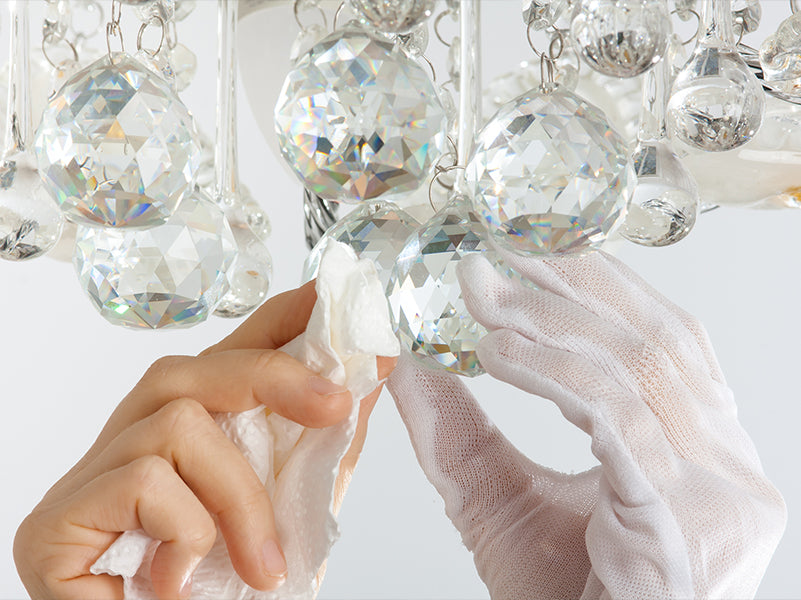
- Maintenance: Dust, fingerprints and cleaning residue soften reflections regardless of the glass type.

This is why it is unreliable to say that K9 always sparkles more than glass, or that lead crystal always looks better than K9. A fair comparison requires similarly sized pieces, comparable cuts, the same light source and the same viewing conditions.
How to choose among K9, lead crystal and glass
Choose K9 when you want crisp faceted forms with broad design flexibility
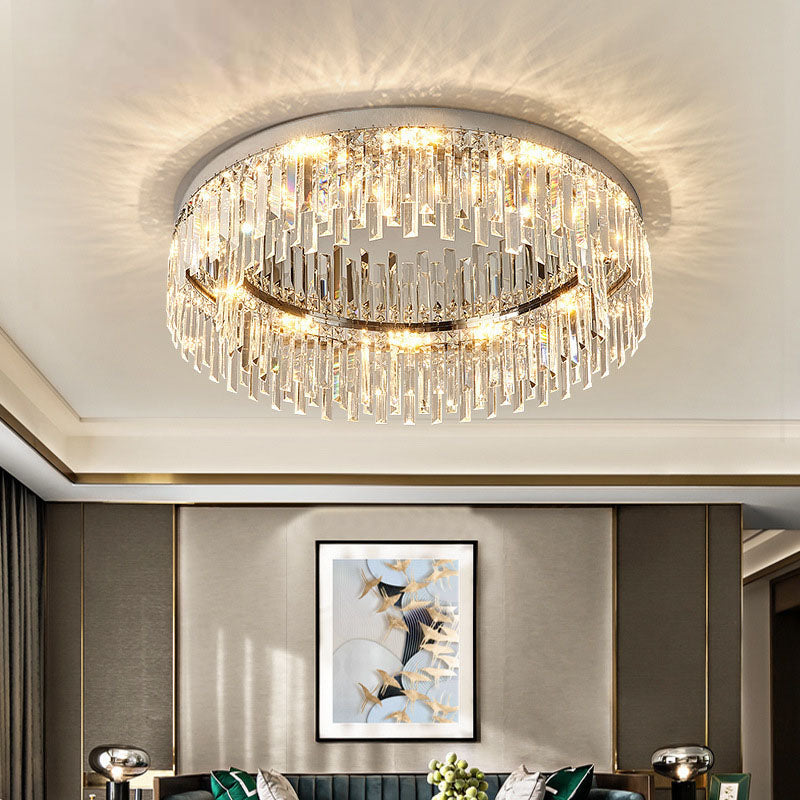
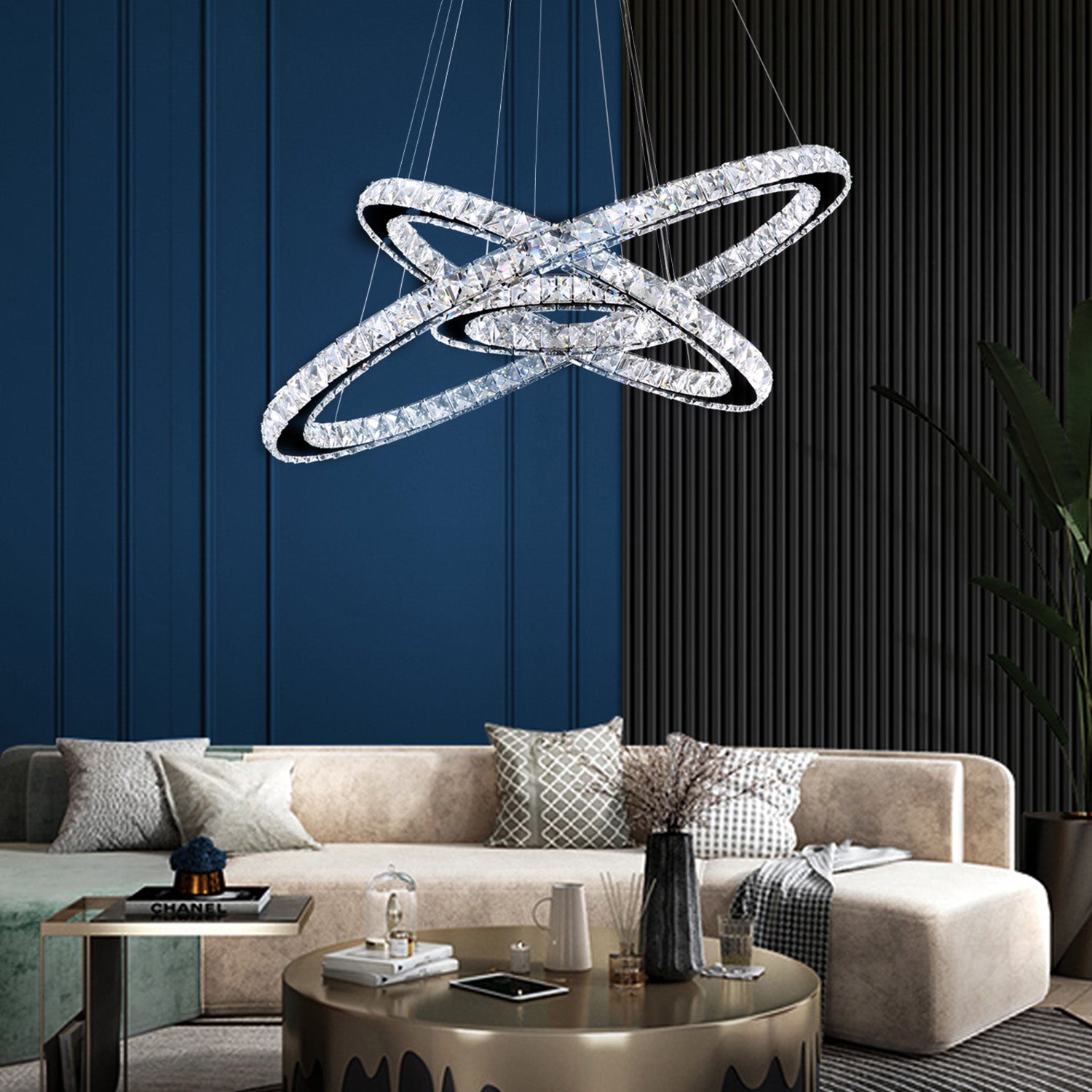
K9-type chandelier components are commonly used in linear prisms, waterfall drops, rings and layered geometric fixtures. The material is especially relevant when the design depends on repeated clear facets rather than a hand-blown glass shape. Before purchasing, verify that the page shows the actual crystal form and publishes the complete fixture dimensions and weight.
Choose documented lead crystal when composition and traditional material character matter
If lead crystal is central to the purchase decision, do not rely only on “premium crystal” or “European crystal.” Ask for the declared PbO content, origin or manufacturer, and any applicable conformity information. Then compare the complete chandelier—not just the crystal pieces—on frame construction, suspension, electrical specification, installation and replacement support.
Choose decorative glass when the design needs diffusion, color or sculptural form
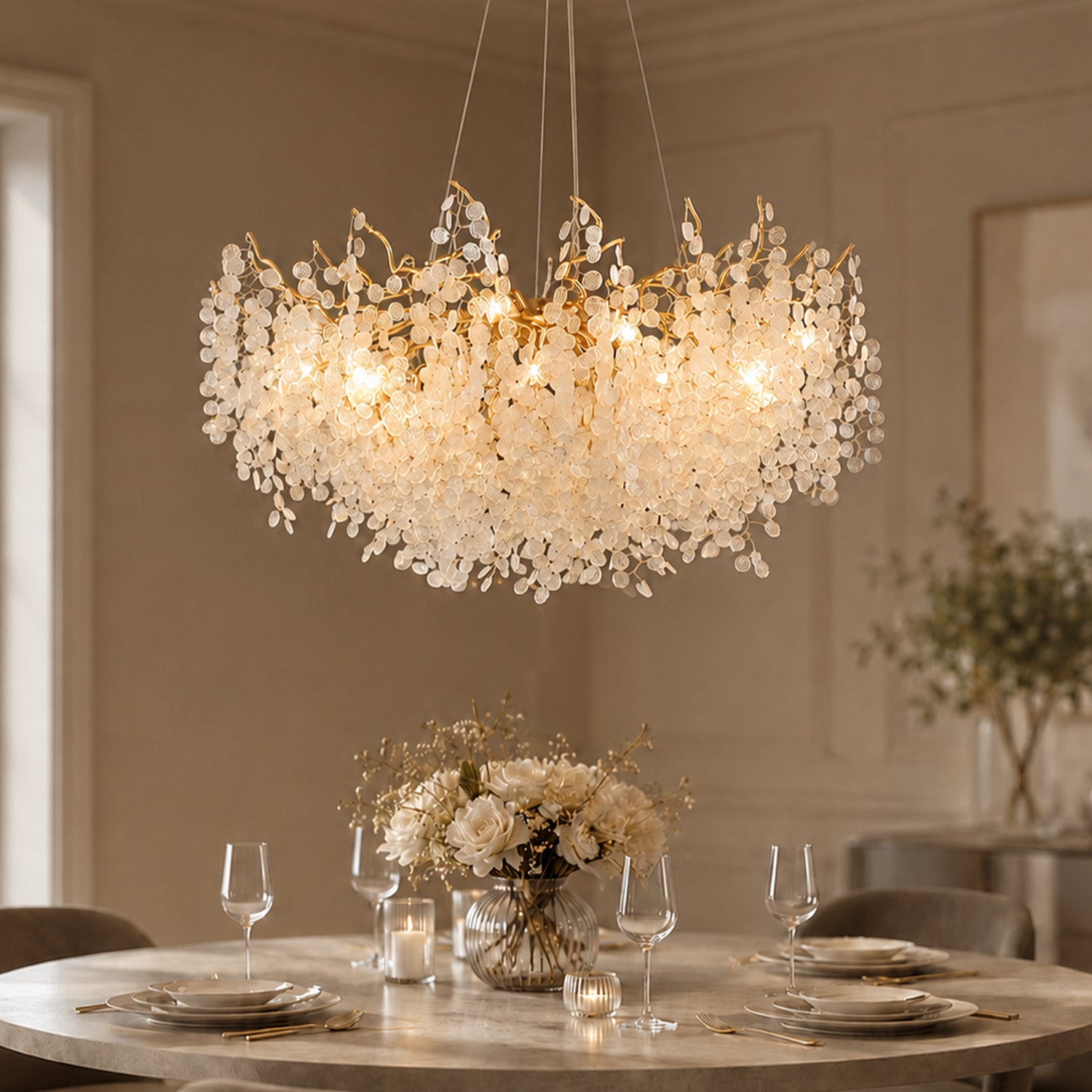
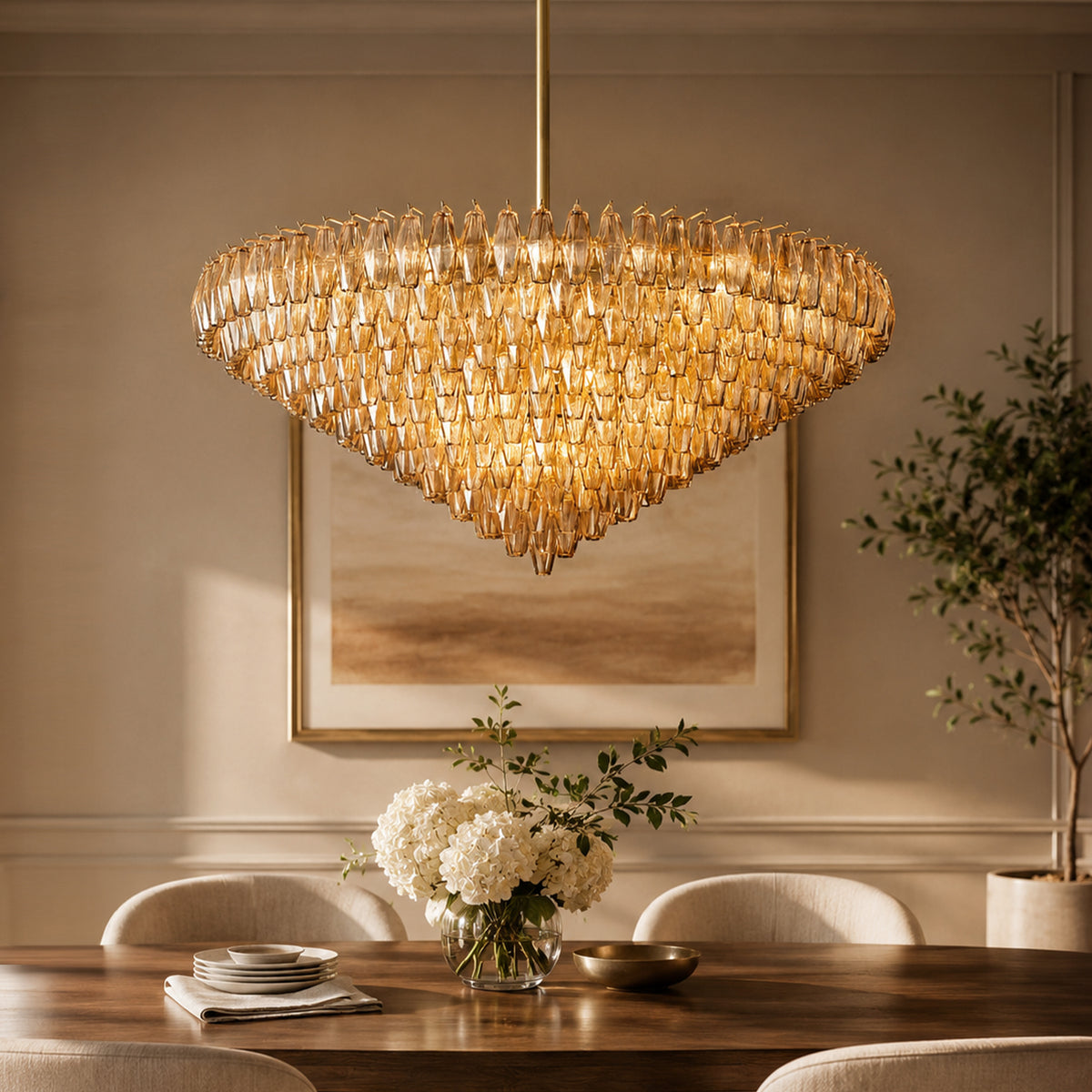
Glass can be the better fit for globes, petals, tubes, textured shades and hand-formed silhouettes. Evaluate the forming method and finish rather than assuming that the absence of the word “crystal” makes the fixture inferior.
Current Sofary K9 examples: choose by form and room
The examples below are not a ranking of crystal quality. They show how the same published K9 material label is used across different chandelier geometries. Product-page specifications were reviewed on August 31, 2026; availability and specifications should be checked again before purchase.
| Sofary product | Published form and size | Best planning use | Evidence limit |
|---|---|---|---|
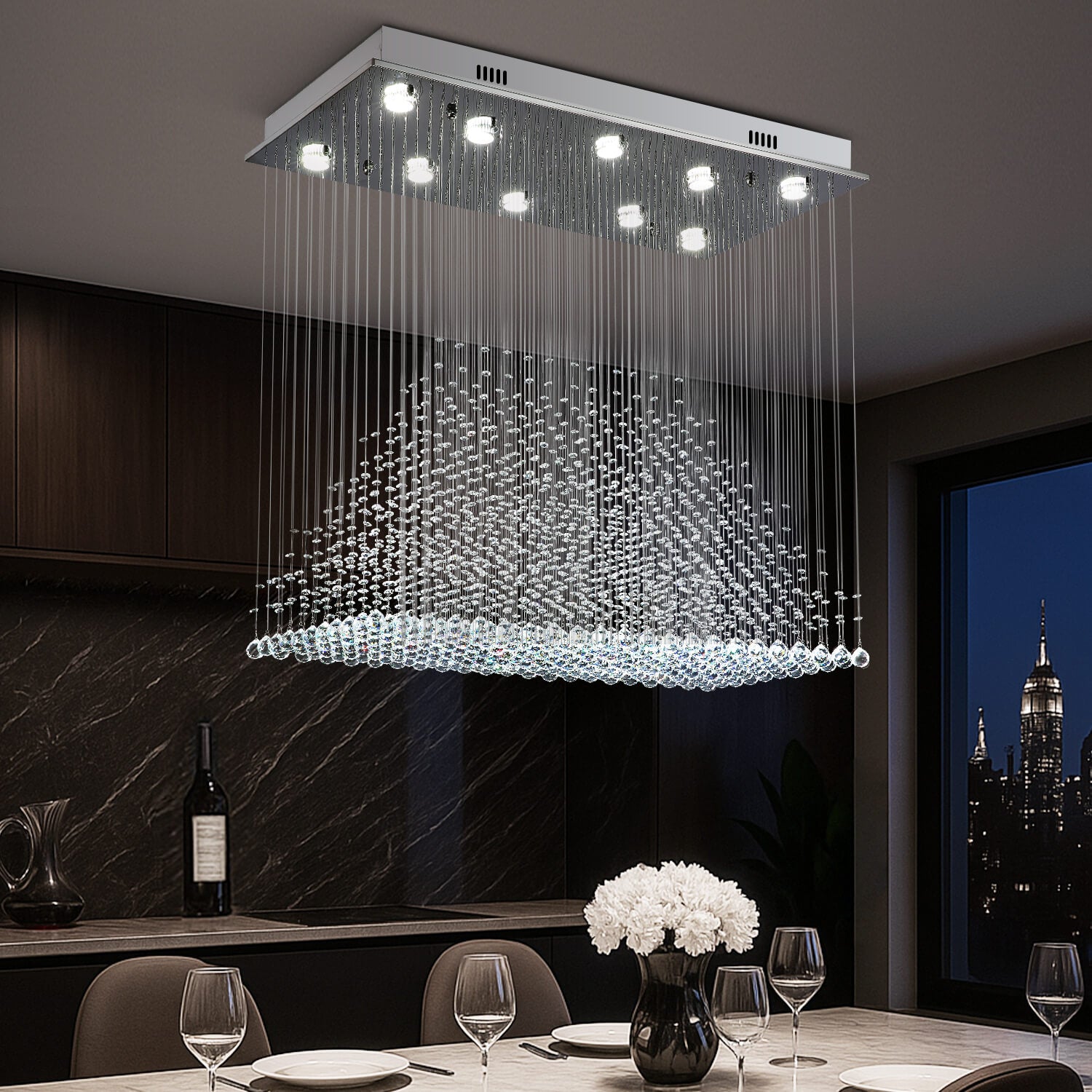
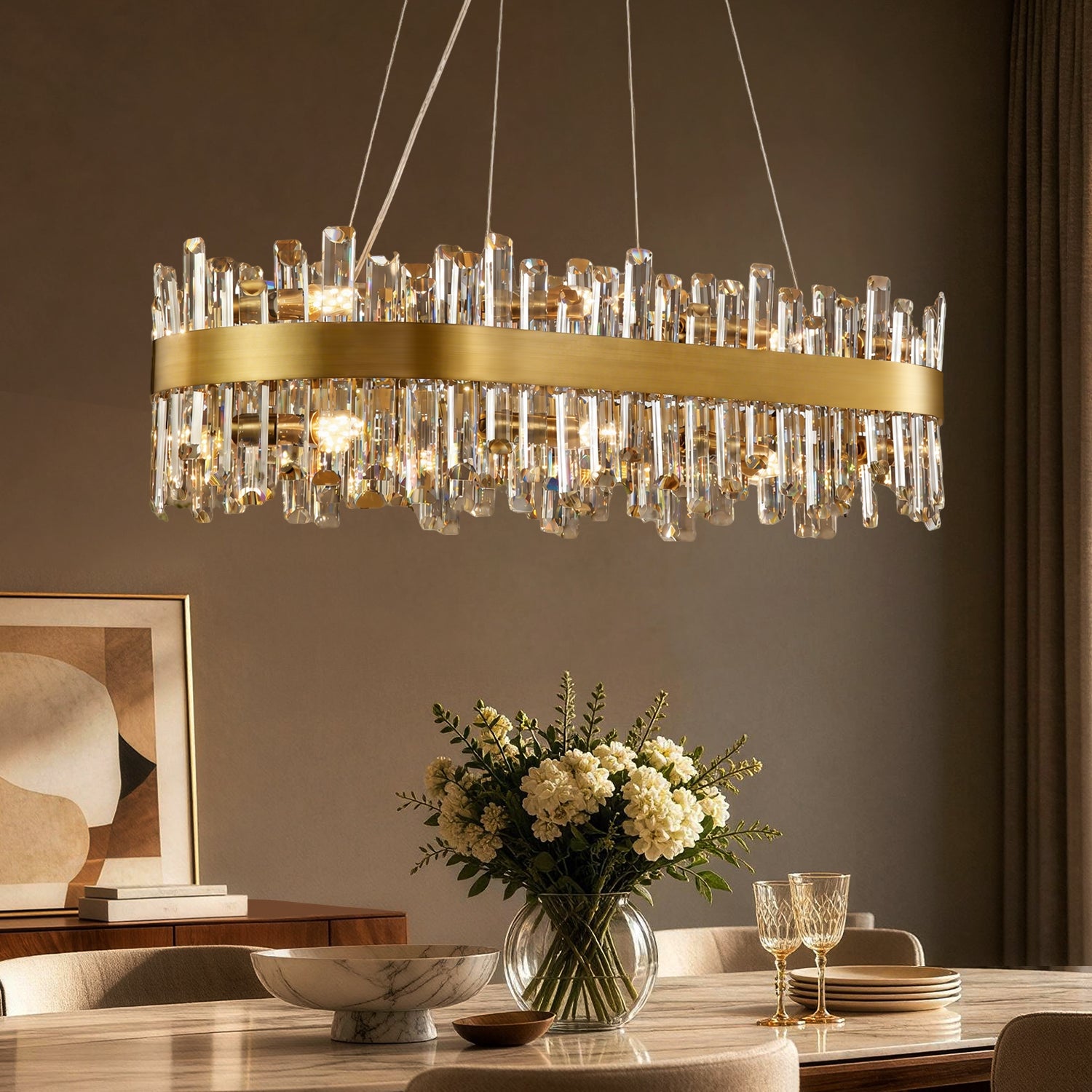
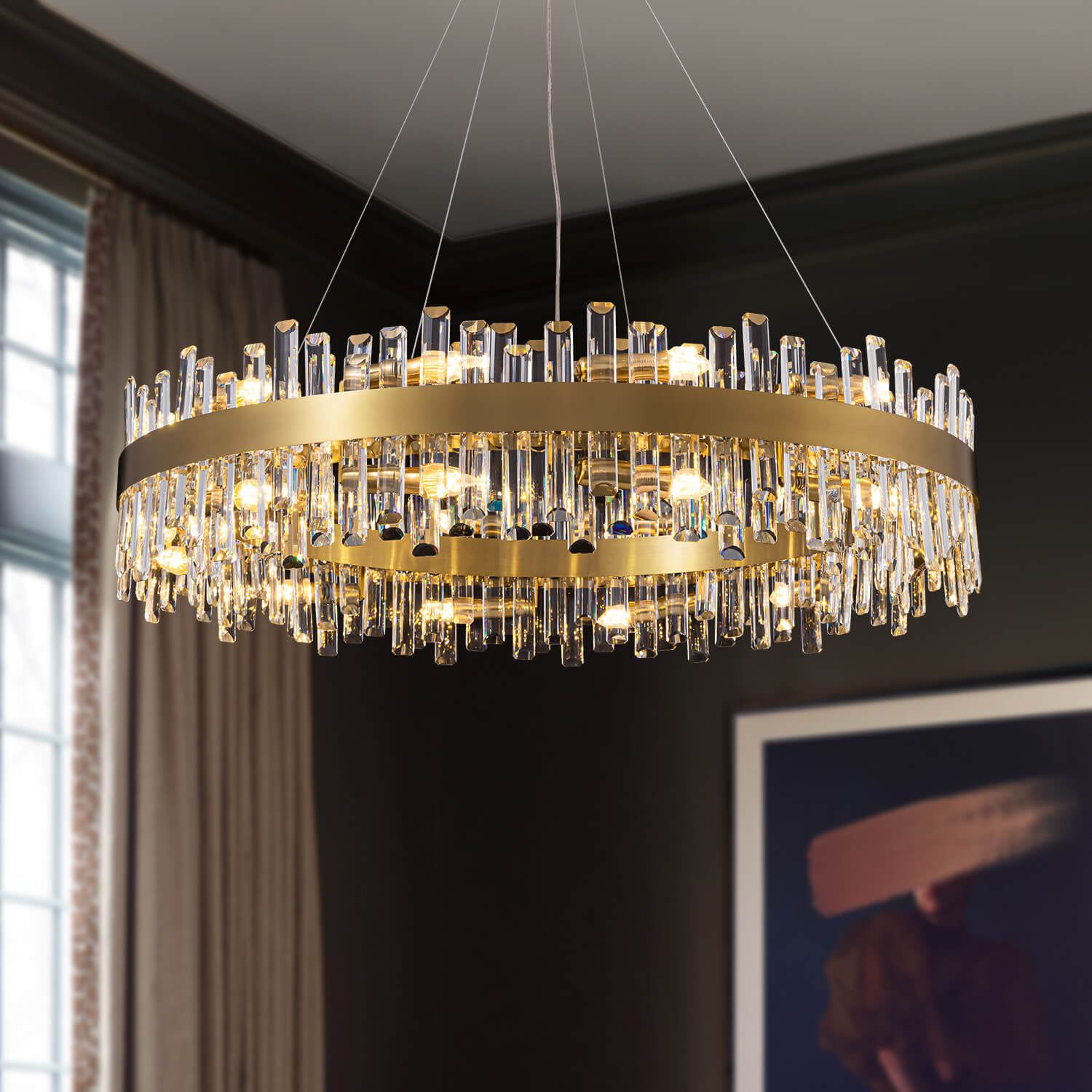
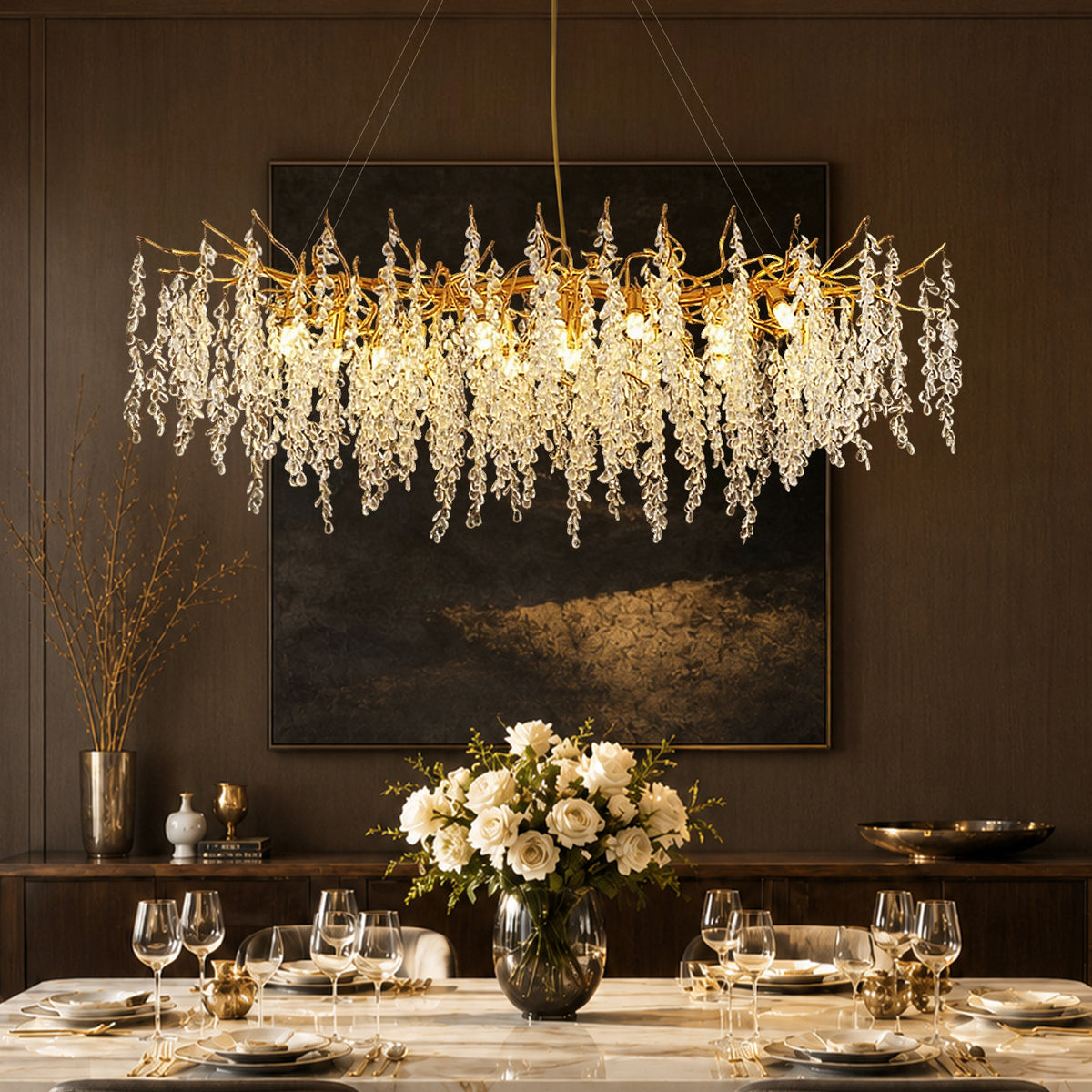
| Stellar Grand Linear Silver Multi-Faceted K9 Crystal Chandelier | Linear faceted-crystal design; published size W 47.2″ × H 14.2″; published weight 67 lb. | Long dining tables and kitchen islands where the fixture should follow the furniture axis. | The inspected page says K9 crystal but does not publish a chemical analysis or H-K9L certificate. |
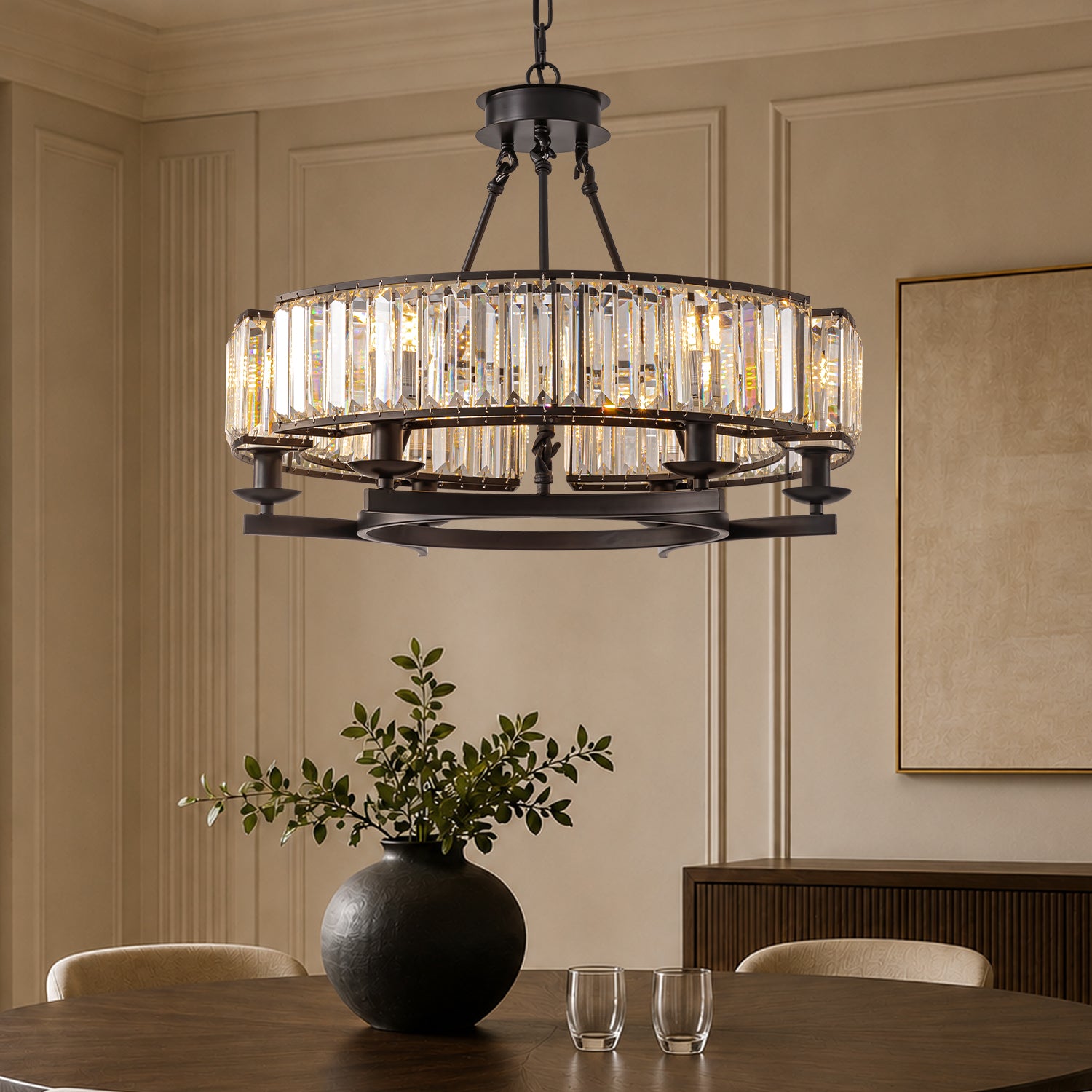
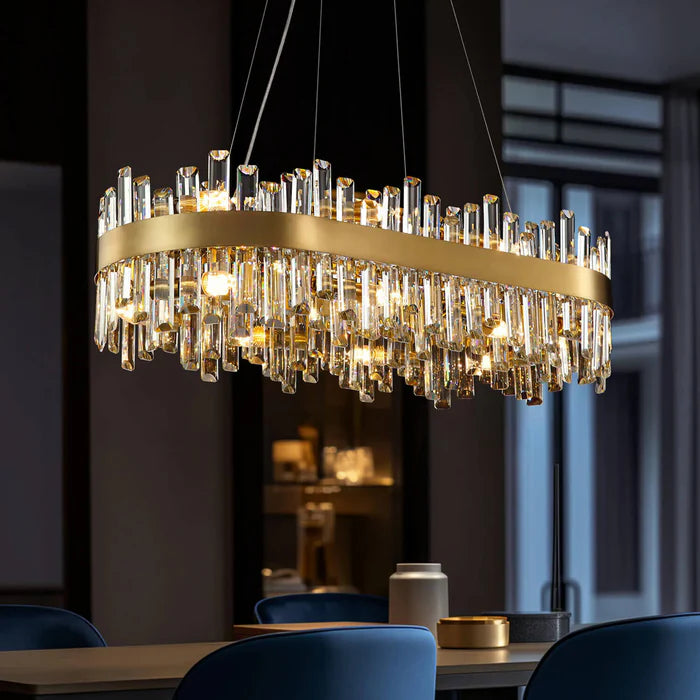
| Valence Modern Large Luxury K9 Crystal Chandelier | Rectangular layered crystal-rod design; published size W 40.6″ × H 12.2″; published weight 39.7 lb. | Dining rooms and islands that need a shallower horizontal fixture. | The inspected page says K9 crystal but does not publish a chemical analysis or H-K9L certificate. |
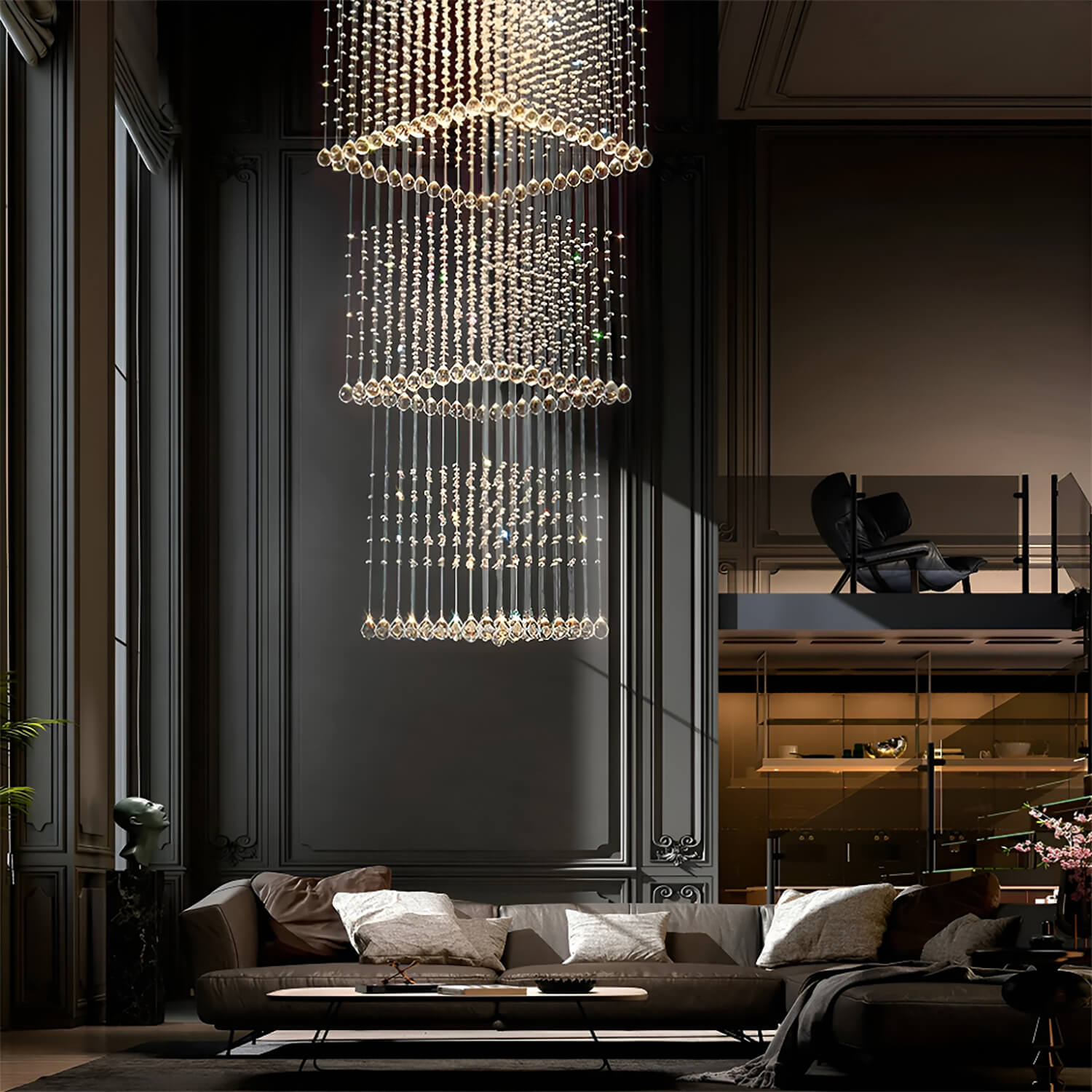
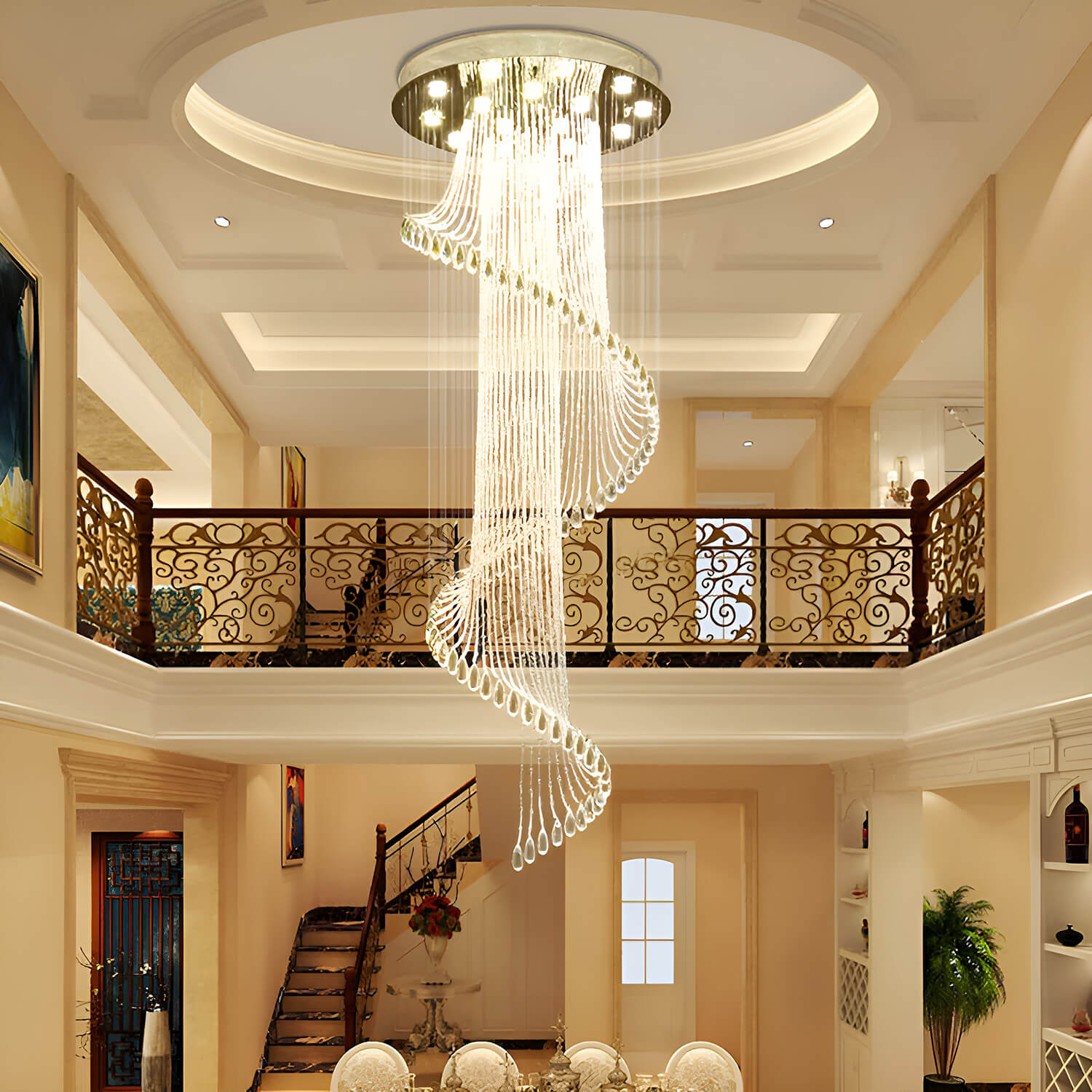
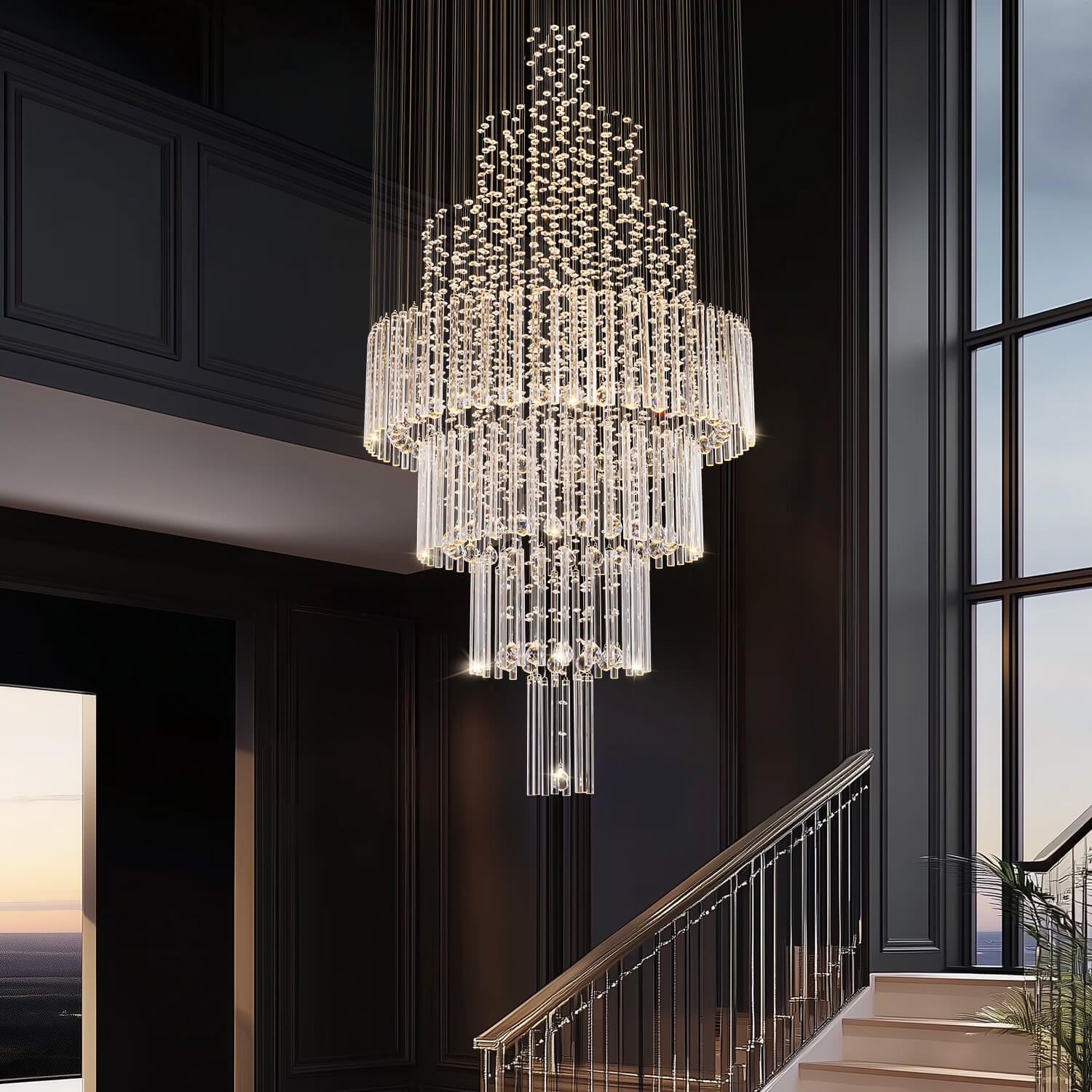
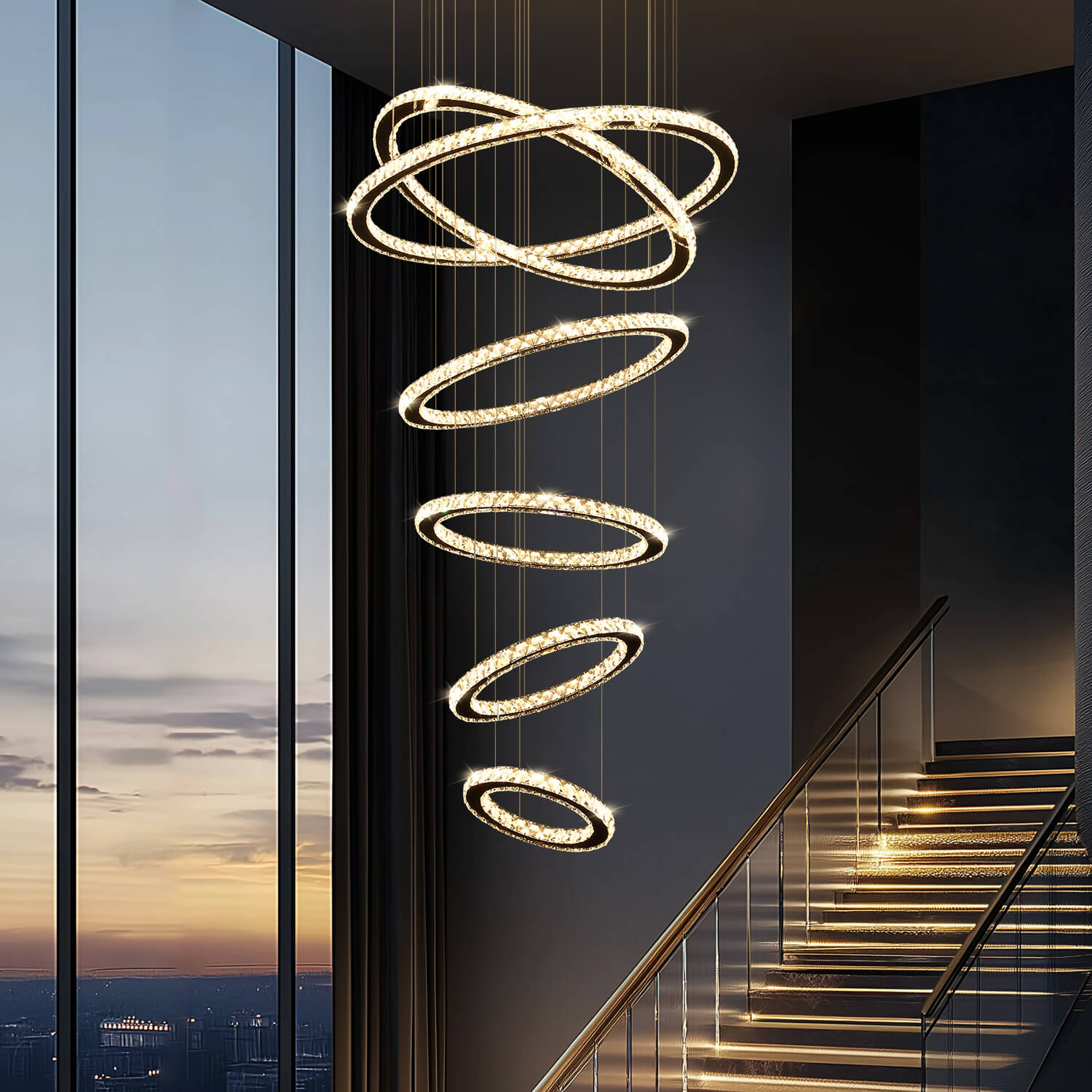
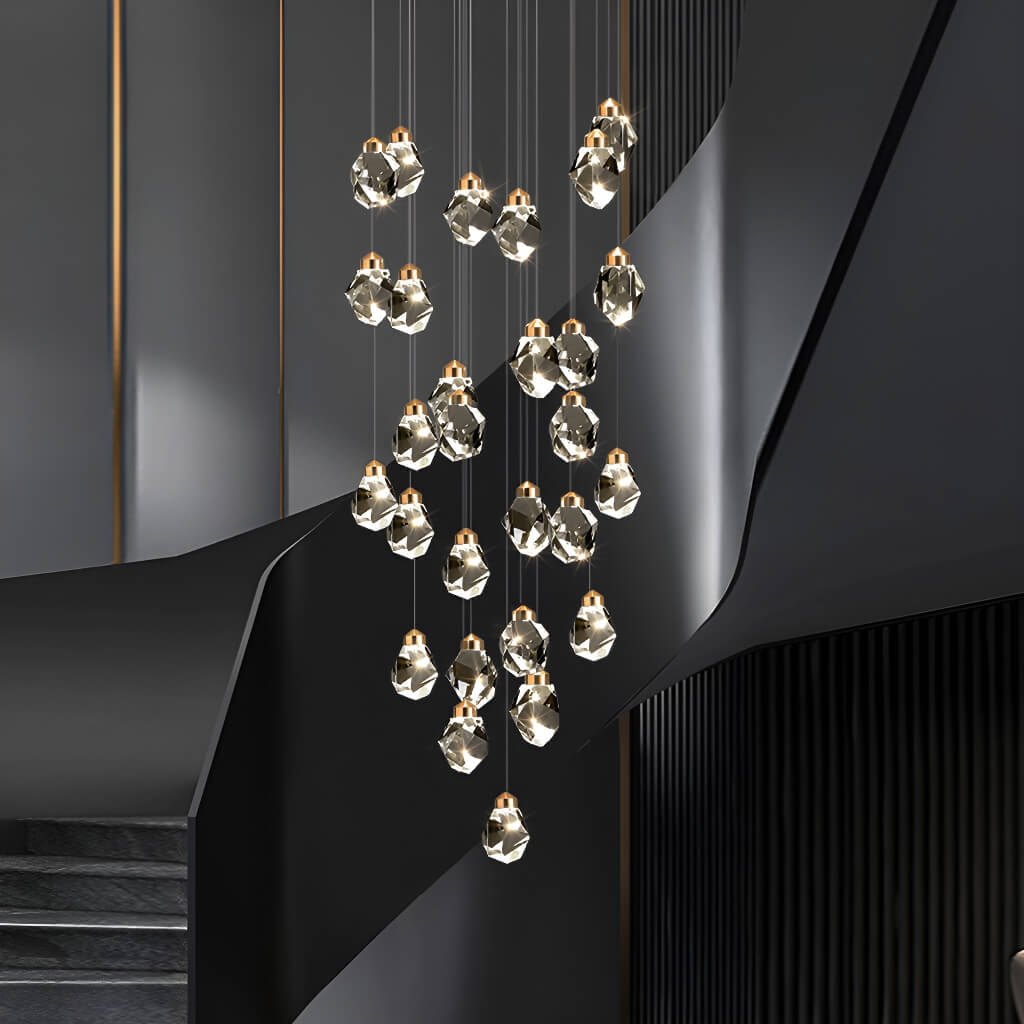
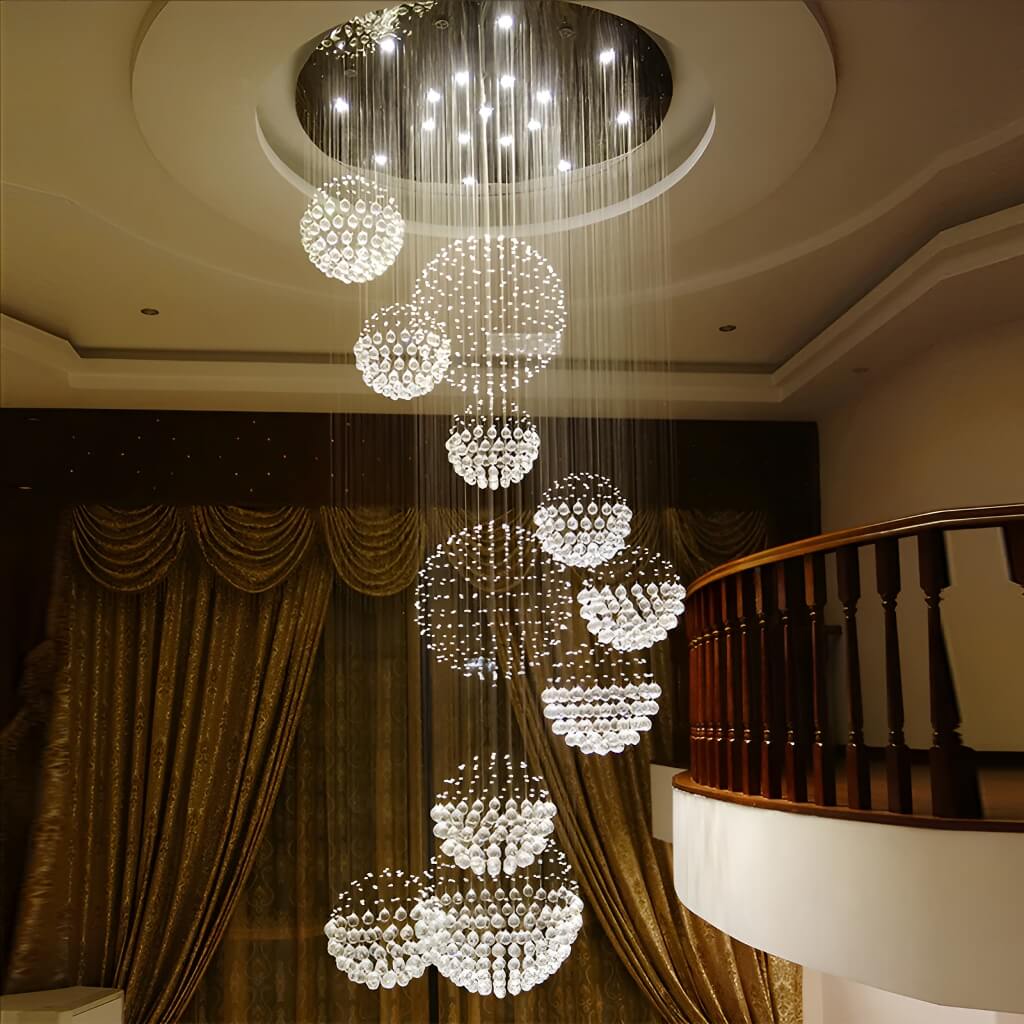
| Aerioz Grand Multi-Tier Waterfall Staircase K9 Crystal Chandelier | Vertical waterfall design; published size D 47.2″ × H 70.9″; published weight 220 lb. | Double-height foyers and grand staircases with sufficient vertical volume and a project-specific support plan. | The page identifies K9 crystal; exact composition is not published. The 220 lb finished weight makes structural verification essential. |

Stellar Chandelier

Valence Chandelier

Aerioz Chandelier
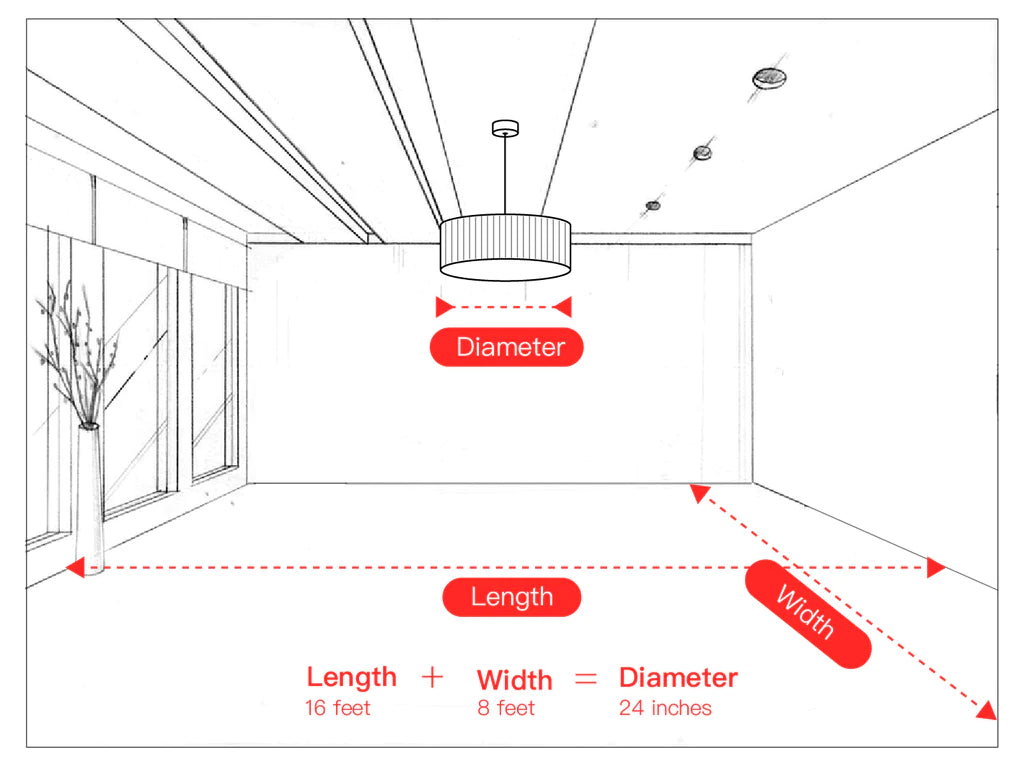
For proportional planning, use Sofary’s dining-table chandelier sizing guide. For heavy or high-mounted fixtures, review the installation guide and confirm the final support method with a qualified installer. Material selection never replaces structural planning.
Do not use price as a material test
A more expensive chandelier is not automatically made from lead crystal, and a lower-priced fixture is not automatically ordinary glass. Price may reflect fixture scale, the number of decorative components, metal construction, finish, bulb count, assembly time, packaging, freight, customization, warranty and seller support.
If you are comparing budgets, first identify the exact material description and fixture specification, then compare similarly sized products with similar forms. Sofary’s chandelier price guide explains why total value cannot be reduced to a single material label.
Questions to ask before buying a crystal or glass chandelier
- What exact material name or grade does the supplier publish?
- If the page says K9, is the supplier referring to K9, H-K9L or a K9-type commercial glass?
- If the page says lead crystal, is the PbO content documented?
- Are the components cut and polished, molded, cast or hand formed?
- Do close-up images show the actual product’s edges and mounting holes?
- What is the total assembled fixture weight—not only the weight of the decorative pieces?
- Are replacement crystals, rods or shades available?
- Are bulbs included, and where are they positioned relative to the decorative elements?
- What cleaning method does the seller recommend?
- Which claims are supported by a specification or test report, and which are descriptive marketing language?

Frequently asked questions
Is K9 crystal real crystal?
In chandelier retail, “K9 crystal” is an established commercial name for clear, faceted glass associated with Chinese K9-type optical crown glass. Scientifically, it is glass rather than a naturally grown crystal. The retail word “crystal” describes the decorative category; it does not by itself certify a chemical composition.
Does K9 crystal contain 9% lead?
The name alone does not prove that. Published descriptions conflict, while a public Chinese K9 optical-glass formulation does not list PbO. Modern H-K9L is separately presented as an environmentally oriented optical-glass grade. If lead content matters, request a declaration or test for the exact material supplied with the product.
Is K9 the same as H-K9L or N-BK7?
Not automatically. H-K9L and N-BK7 have closely corresponding optical values and appear in manufacturer cross-reference systems, but equivalent optical values do not guarantee identical composition. A chandelier page that says only “K9 crystal” should not be upgraded to a specific H-K9L or N-BK7 claim without documentation.
Is lead crystal always more brilliant than K9?
No universal visual ranking can be made from the material names alone. Lead content can affect density and optical behavior, but the finished appearance also depends on facet geometry, polishing, thickness, light-source position and cleanliness. Compare finished samples or like-for-like close-up images under similar lighting.
Is ordinary glass lower quality than K9?
Not necessarily. Ordinary glass is a broad description. It may be the correct material for blown globes, diffusing shades, textured panels or colored sculptural pieces. The relevant questions are how it was formed and finished, whether the appearance is consistent, and whether the whole fixture is properly specified.
Can I identify K9 or lead crystal by sound, weight or a photograph?
Those observations may suggest differences, but they are not reliable composition tests. Finished shape, thickness, mounting hardware and scale all affect sound and weight, while photographs are affected by exposure and lighting. Use supplier documentation when material composition is important.
Which material is best for a large foyer chandelier?
Start with total size, finished weight, available drop, viewing distance, cleaning access and structural support. K9, lead crystal and decorative glass can all work in a foyer, but none of them makes an unsuitable mounting plan safe. Large fixtures require project-specific verification.
Methodology and evidence limits
This article distinguishes published facts from editorial buying guidance. The Chinese K9 context was reviewed through published optical-glass information, including a Chinese K9 formulation, CDGM’s current H-K9L listing, SCHOTT’s N-BK7 data sheet and HOYA’s cross-reference caution. The European crystal-glass directive was used only as a transparent example of composition-based terminology, not as a claim that EU labeling rules govern every U.S. chandelier listing.
Sofary product examples were checked against their live product pages on August 31, 2026. Those pages publish the K9 material label, dimensions and finished weights used above. They do not publish chemical analyses for the crystal components, so this guide does not claim that every listed Sofary product uses H-K9L, contains a fixed percentage of lead or meets precision-optics manufacturing tolerances.
Sources: published Chinese K9 optical-glass formulation; CDGM colorless optical-glass information; SCHOTT N-BK7 optical-glass data sheet; HOYA optical-glass cross-reference; and EU Council Directive 69/493/EEC on crystal glass.
More Blogs
What Should You Take into Consideration When Buying a Chandelier?How to Find the Best Staircase Chandelier for Your HomeHow to Pick the Perfect Chandelier Ceiling Fan for Your Living RoomHow to Choose Matching Lamps with Chandeliers ?How to Choose the Right Light Bulbs for Your HomeHow to install crystal chandeliers | Sofary LightingThe Lighting Guide: How to Light Your FoyerChandelier Ideas: A Guide to Choosing the Right Crystal ChandeliersYour Guide to the Top Types of Crystal For ChandeliersCrystal Chandelier Maintenance: How to Keep It Sparkling Like New